SOC Power Stacks
Hydrogen Stacks for R&D and Industry
SOC-Stacks: Production Alliance for Technology Transfer and Industrialization
Researchers at Forschungszentrum Jülich are working with regional companies to establish a production network for SOC (solid oxide cell) stacks. The aim is to transfer knowledge from research into industry, support sustainable employment and actively support structural transformation in the Rhineland mining region.
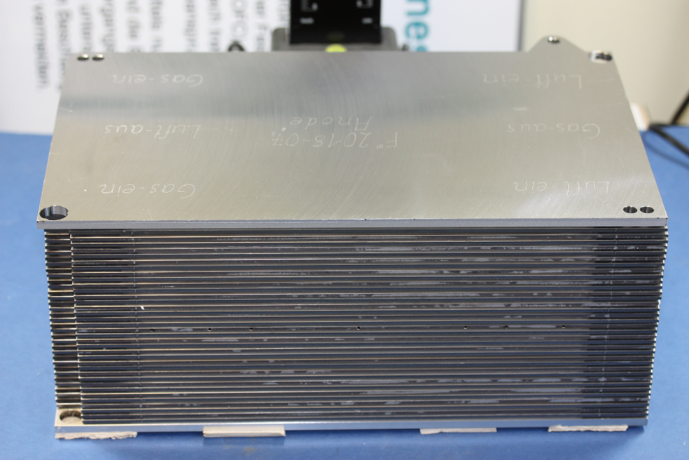
SOC Power Stack: H2020 Stack after assembly
The energy transition is increasing the demand for hydrogen and, consequently, for high-performance electrolysis technologies. According to the World Energy Outlook published by IRENA in 2023, hydrogen will have not the major but a decisive role in the energy mix in 2050. The share of hydrogen in the energy mix 2050 worldwide will be around 14%. For this high amount of hydrogen needed in 2050, a huge electrolysis capacity is required. Hydrogen can also be stored and re-electrified in a fuel cell, as well as be used as a sustainable feedstock for the chemical industry (power-to-X: power-to-fuel, power-to-chemicals, power-to-heat, etc.), thus facilitating the large-scale integration of renewables, enabling efficient global energy logistics and locally supporting the balancing of the grid. Due to its versatile application possibilities, hydrogen plays a key role in a future sustainable energy system as a coupling element for different sectors. Several electrolysis technologies exist so far that are at different technological maturity levels. The SOC technology is not yet mature and only few companies produce SOC stacks worldwide. The high-temperature electrolysis (SOEC) is due to its high operating temperature predestined to be regarded as a key technology for sector coupling. SOC technology in particular offers a wide range of applications and high efficiency through H₂O, CO and CO₂ electrolysis, as well as reversible (rSOC) applications achieving the highest efficiency rates due to advantageous thermodynamics and reaction kinetics.
Forschungszentrum Jülich has been heavily involved in the SOC research for more than three decades and has become a cornerstone of the global SOC research community. JÜLICH has been developing in these years a kW-class SOC stack design (H20) dedicated for use in stationary and large applications. It is a robust planar design with internal manifolds and with four cells per layer to achieve high active areas per repeating unit. The stack design showed in last years in several tests a very robust thermomechanical behaviour, high stack repeatability and very high performances[1]. A maximum electrical net fuel cell system efficiency of 63.3 % at a system power output of 10.4 kWAC could be shown in a demonstration system containing four H2020 sub-stacks. The maximum DC stack power was recorded as 14.3 kW at 650 mA cm-2 in the fuel cell mode. During the electrolysis mode, a net system efficiency of 71.1 % (LHV) at a current density of - 1100 mA cm-2 with a corresponding input power of - 49.6 kWAC and a steam utilization of 80 % was achieved, producing 11.7 Nm3 h-1 hydrogen [2],[3].
[1] Ludger Blum et al. 2017 ECS Trans. 78 1791
[2] Roland Peters et al. 2023 ECS Trans. 111 1657
[3] Roland Peters et al. 2023 Journal of Electrochemical Society 170 044509
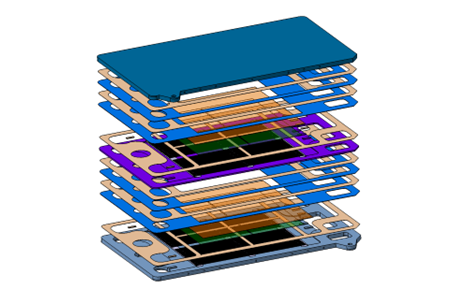
Exploded view of a short stack in the H20 design
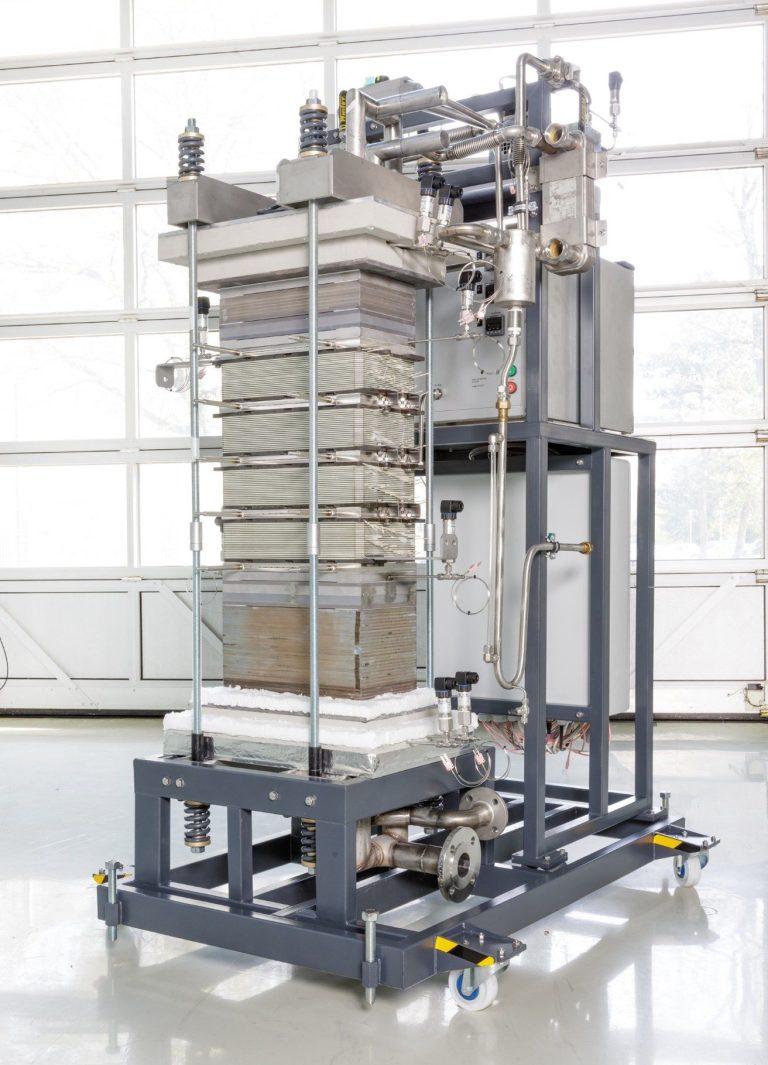
Reversible SOC system of Forschungszentrum Jülich with four H20 stacks as part of an integrated module. © Forschungszentrum Jülich, Ralf-Uwe Limbach.
All these stacks have been manufactured and build-up within the laboratories of the Forschungszentrum Jülich. Solid Oxide Cell (SOC) technology is currently experiencing a high level of interest, as the capabilities and the potential of the technology are well aligned with the global efforts to achieve zero emissions. We have faced an increasing demand for stacks over the last years. Therefore, we have decided to transfer this technology to the industry. With this step we are looking for new impulse in the production and assembly processes leading to cost reduction and quality increase.
The network brings together four regional companies in a production consortium for high-temperature electrolysis stacks. It links research and industry, strengthens small regional businesses in the Rhineland mining region and ensures that industrial know-how is specifically incorporated into technology development. At the same time, the aim is to transfer knowledge, support the transformation of specialized companies, support sustainable employment and promote sustainable employment.
The consortium partners of the “SOC production Alliance Jülich” are Schiffer Metall- & Vakuumtechnik GmbH in Jülich for manufacturing, stack assembly and coordination, EUROMAT GmbH in Baesweiler for the coating of functional ceramic layers, WZR ceramic solutions GmbH in Rheinbach for powder production, joining materials and screen printing of sealant green foils, and AIXcellSYS GmbH in the Herzogenrath Technology Park for stack joining and end-of-line testing.
20+
years of experience
5
alliance members
30+
scientific publications